

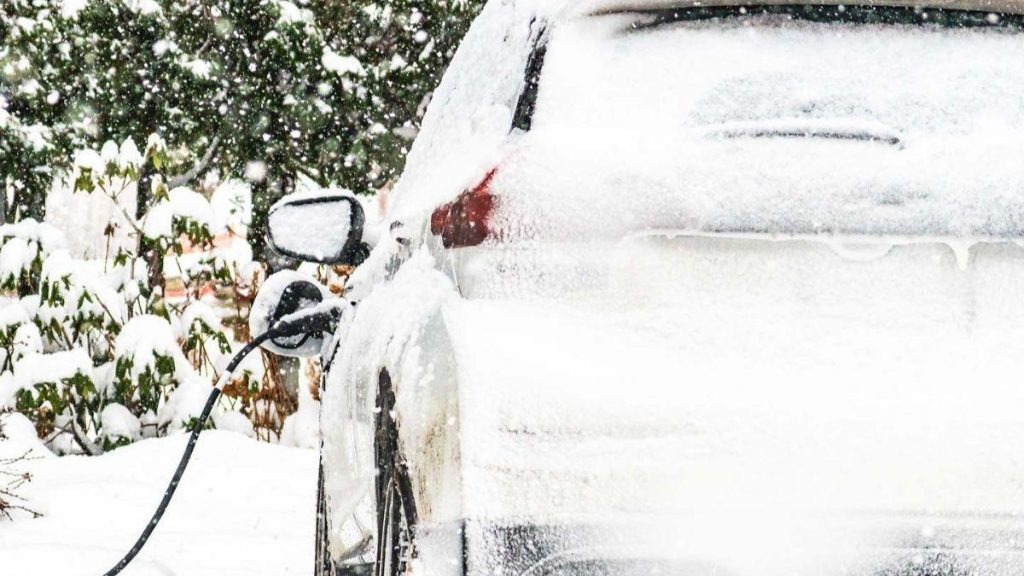
The past month brought an unexpected blast of cold winter weather to much of the country and it affected the lives of millions. One news coverage that was a first during this weather anomaly was the prevalence of failure of EV batteries and chargers in extreme temperatures. It had me thinking, what is the reliability of EV batteries to operate in -9℉? What happens to the EV charging infrastructure at those temperatures? The last thing you want is to pull up on a charging lot to find a broken charger cable or a failed charger port.

Batteries have internal heaters to warm it up when the external temperature drops below its operating range. They need to be warmed up to charge. A cold battery will not charge when you plug it into a charger. It is also slower to reach a full state of charge when it is cold. When you drive up to charge at an extremely cold temperature, the first few minutes of charge will be spent to warm up the battery before it refills the battery. That’s a neat solution. We can tune the heater capacity and limit it to solve this problem. Suddenly, the supporting heater (moderate critical) component becomes a life-saving component (high-critical). Failure of the heater at this criteria will be costly. So, when the reliability of the heater is set & assessed during the design stage, it must be evaluated with this in mind. Some of the questions to answer would be: Will it fail under severe weather? What is the consequence of that failure?
What about the chargers themselves? They are separate systems that integrate electricity, software, and network into one. Failure of any one of these will lead to unreliability of chargers. As observed by WSJ in its report of the charging network in Los Angeles, close to ~40% of chargers were unavailable for customers on that given day. EV Charger manufacturers must adopt Reliability validation in their product development to test out the longevity of their components. Due to the surge in market demand, many would’ve had short development time making them restricted from doing validation testing. A lightning-fast reliability method: HALT, ALT, and RG will be apt for them. It means doing a highly accelerated life test to discover hidden failures, updating the design marginally, measuring improvement by accelerated life testing, and then releasing the product. Measure its performance in the field and iteratively improve further through reliability growth testing.

One question to ask is, what will be the high-level impact on EV adoption and the automobile market due to this unreliability? Reading this news will certainly deter a few customers who are thinking of buying an EV. The customer will be smart to know that these are extreme cases that are outside their normal use. But it does not mean the EV manufacturers have no work to do. They now face the daunting task of convincing the customer that their vehicles and charging network will withstand nature.
Last month, I demonstrated the awesome towing capability of Rivian R1T. I towed 7000 lbs of Humvee repeatedly stressing their batteries and structure. But it worked fantastic! I’m not sure if their engineer thought of designing it for this Use Case but they had so much margins and reliability in their components, that it withstood the extreme stresses we applied. That is a lesson to take for manufacturers of EV chargers. The electronics, wiring harnesses, software, panels, and plastic enclosures all must be designed with high margins to withstand the extreme cold of Chicago or the extreme heat of Phoenix – all the while lasting for years to make economic sense.
Use Case 7 is the method I implement with my clients when dealing with a wide range of operating conditions. In addition to it, apply reliability tools like HALT/FMEA to analyze the risk of your design and improve its robustness.
Are you involved in the development/installation/service of EV vehicles or EV chargers? What is your observation of system reliability? Let’s talk!
-Adam