

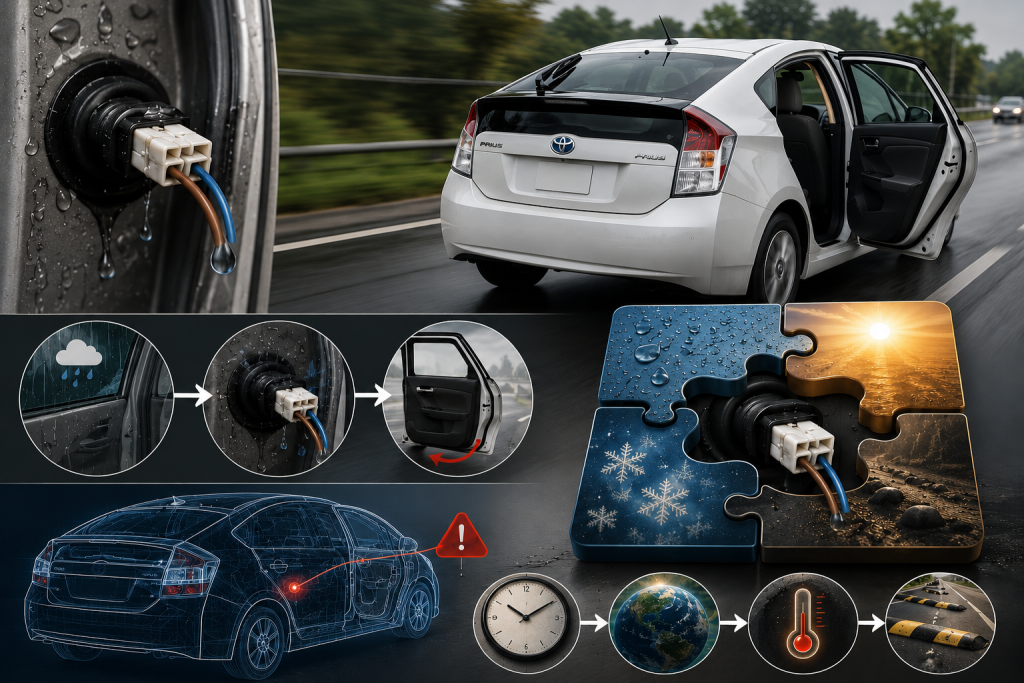
I recently came across a recall involving the Toyota Prius.
Over 140,000 vehicles were affected.
The issue?
Rear doors that could open while the car is in motion.
At first glance, it sounds like a simple defect.
But the root cause is more revealing.
Water could enter the rear door switch.
Under certain conditions, that moisture could cause a short circuit.
If the door was unlocked, it could open while driving.
Which raises an important question.
How does something as small as moisture
lead to a system-level safety risk?
The answer is not a single failure.
It is a combination of conditions.
Seal degradation over time.
Exposure to water.
Thermal cycling.
Mechanical stress from normal use.
Individually, these may not cause failure.
Together, they create it.
There is a clear parallel here in product development.
Failures rarely come from one obvious cause.
They emerge from interactions.
Between components.
Between environments.
Between assumptions made during design.
Which leads to an important question.
Are you testing components in isolation
or understanding how they behave together?
Reliability is not just about whether something works.
It is about how it behaves under real conditions.
Over time.
Across environments.
Under combined stresses.
Because real-world failures are rarely clean.
They are layered.
As you think about your product:
Where could environmental factors introduce risk?
What assumptions are you making about sealing and protection?
What conditions need to align for failure to occur?
Some failures are not obvious during testing.
They appear when multiple small factors come together.
I found this a useful reminder of how reliability issues often develop quietly—until they don’t.