

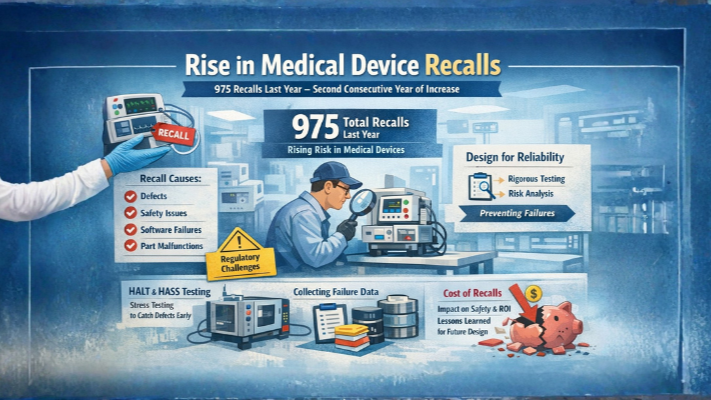
In a recent report, it was found that the total recall events in the Medical Device industry have increased to a total of 975 for the past year. This is the second consecutive year of an increase in recalls. Recall events are calls from the manufacturer to repossess the device from the customer to correct a problem. The problems might be quality defects, reliability part failures, safety risks, software bugs, or any other hazard.
The medical device industry is regulated by standards yet many problems slip through the inspectors, putting users in jeopardy. A robust medical device product will consider all aspects of its use cases – from indoor safe use to outdoor coarse use – and build sufficient margins in the design. The margins will also add reliability against the manufacturing variability. Integrating Reliability goals at the start of the development process will allow the team to assess the risk of design, conduct tests to understand weak points, and take improvement actions. The design process iteration is constrained by resources, time-to-market, and costs. The Product Ratio Factor is one way to balance this by using the other tools in the Design for Reliability toolkit. They will complement the software models, test results, and risk analysis to improve design.
Quality-related defects are one of the common issues that trigger product recalls. A well-defined Highly Accelerated Stress Screening (HASS) designed from the results of HALT will empower manufacturers to screen out defects before it is shipped to the customer. The Quality Assurance team can co-own the screening process by sharing the tool. Collecting the failure records during manufacturing and even from the customers will help the firm build a database that designers can refer to.
Recall of the product is a massive hit to the firm. Customer safety is of prime importance in any engineering work. The silver lining is it does provide the firm with the knowledge of product weakness and the cost of dealing with a recall. This can lay the foundation for future Program Risk Effect Analysis ROI decisions. If you want to change a design at a mature stage but are worried about cost, think of the costs associated with recalling the product. You’d be inclined to change a mature design.
– Adam